18
months to online today
Faster
Engineered shell assembly in 12 weeks, with a roadmap toward 12 months site-to-revenue—not five years.
Built for intelligence. Designed for tomorrow.
NeoDomes licenses an integrated, dome-based infrastructure platform that pairs high-density compute with biomimetic cooling and behind-the-meter power. Modular, adaptable, patented design — because the future is inevitable.
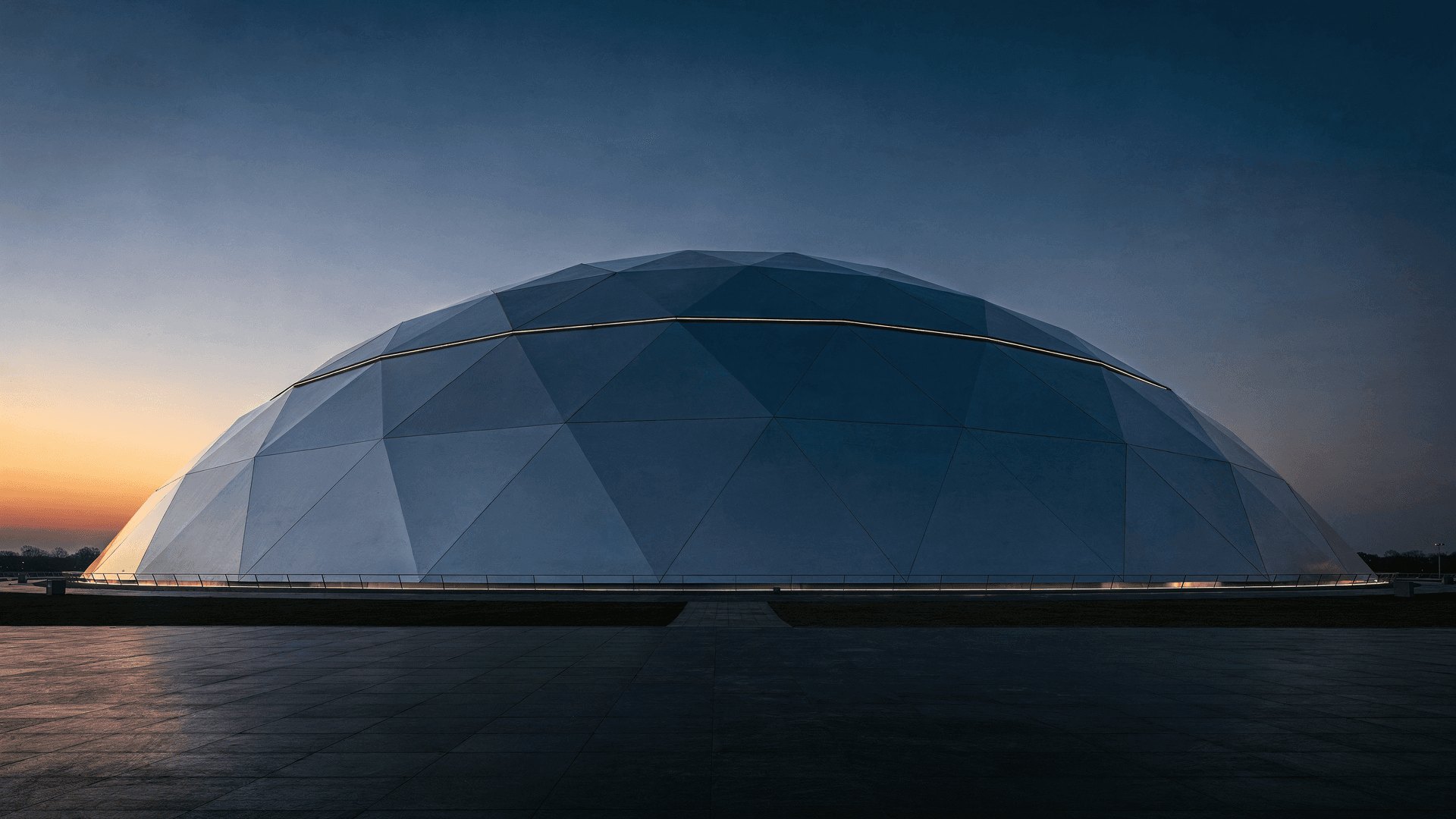
Modular · adaptable · patented design
Compute + Cooling + Power
01 / The thesis
The infrastructure decides who leads it.
Utility interconnect queues stretch 4–7 years in major power markets. Companies that solve their own power problem can move first.
Infrastructure capital now requires lower cost per MW, faster time-to-revenue and a defensible moat—together, not separately.
New capacity must reduce water use, noise, land impact and permitting friction to become a welcomed neighbor.
02 / A different category
Every layer of the data center, redesigned for AI-native infrastructure.
18
months to online today
Engineered shell assembly in 12 weeks, with a roadmap toward 12 months site-to-revenue—not five years.
$10–11M
all-in CapEx per MW
Compared with $14–17M industry-typical AI-ready facilities. Less steel, concrete and power loss.
<1.13
sustained PUE
Up to 90% less water, a compact footprint and low-noise envelope designed to belong in its community.
Not a better version of the old data center. A different category.
Building capacity, deploying capital or bringing a market opportunity?
Talk with NeoDomes03 / Constraint map
Conventional hyperscale facilities were built for generalized cloud infrastructure—not dense, power-intensive, thermally demanding AI workloads.
Accelerators, CPUs & custom AI silicon
Capacity, bandwidth & pooling
Intra-rack, cluster & AI-WAN connectivity
Liquid, immersion & closed-loop thermal systems
Generation, storage, dispatch & resilience
Workload-aware capacity scheduling
Siting, footprint & community fit
Speed-to-shovel, speed-to-megawatt
04 / The platform
Most operators stack separate systems and separate compromises. NeoDomes engineers them as one.
The Dome
01Faster, cheaper, permittable.
The Intelligence
02Proprietary AI software that compounds.
The Network
03National fiber. A platform, not a portfolio.
The Power
04Behind-the-meter. Grid-strengthening, not grid-burdening.
Each layer is hard. Together, they are uncopyable.
05 / Convergence
Technology and market forces have converged to make a small-footprint, energy- and water-efficient data center a critical complement to hyperscale infrastructure.
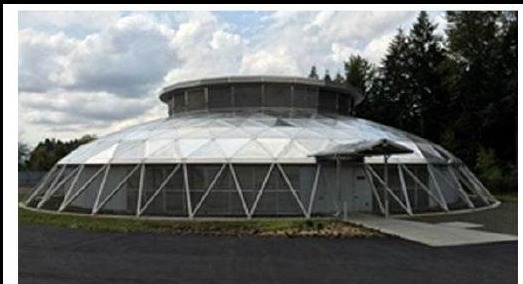
2013 · Generation 1.0
4 MW free-air operating data center. Validated dome physics, cooling-load reduction and low-impact footprint at meaningful commercial scale.
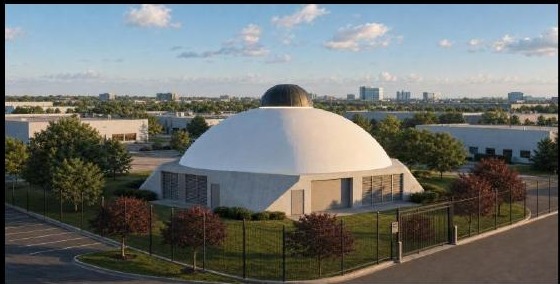
2026 · Generation 3.0
Engineered manufactured envelope. AI-native, liquid-cooled, modular and repeatable. Positioned for patent protection and licensing.
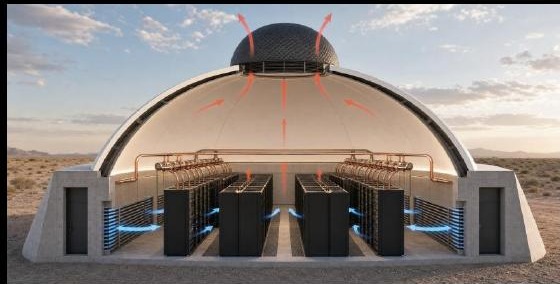
Generation 3.0 · Interior
Copper distribution, passive thermal stratification and high-density rack architecture native to GB200-class workloads.
165% increase by 2030; inference 2→54 GW
~5-year interconnection wait; 226 GW ERCOT queue
Moratoriums, water and noise pressure
50–250 kW racks now standard
$830M data-center ABS in Feb. 2026
06 / Speed & savings
Two questions every operator asks. Two answers built into the geometry.
Speed to market
Modular fabrication, the geodesic shell and behind-the-meter power compress the build envelope from years to months — turning delivery risk from a wildcard into a schedule. Watertight build in roughly 12 weeks; first-revenue dome typically live in under 12 months from groundbreak.
Savings
Lower PUE, near-zero water use and earlier go-live compound into a different financial profile from day one — per 50 MW campus over five years.
Representative model: 50 MW IT load, $0.08/kWh wholesale energy, PUE 1.13 vs 1.50 baseline, $0.10/kWh contracted revenue, 18-month earlier go-live. Real numbers depend on site, contract structure and energy mix.
07 / Biomimetic engine
The geodesic dome isn't a logo — it's the engine that aerodynamically moves heat the same way the planet does.
01 · Passive convection
The dome's curved interior creates natural convection currents that move heat without the chiller plants and water loops conventional designs depend on.
02 · Built for AI density
Hybrid air (10–25 kW), direct liquid (40–100 kW) and immersion (150–300 kW) cooling supported out of the box. Vendor-neutral hardware, scaling from a single 10–20 MW dome to 100 MW+ campuses.
03 · Geometry that compounds
Geodesic triangulation carries structural load with roughly 30% less material than a comparable rectangular shell, opens a column-free interior for any rack layout, and assembles in modular phases.
The proof
Metric
NeoDome
Conventional
Advantage
PUE
Sub-1.13 sustained
1.4–1.6 typical
Up to 27% less power loss
Water use
~90% less
Millions of gal/day
Near-zero evaporative draw
Efficient build
~12 weeks
6–12+ months shell
Months, not seasons
Time to live
< 12 months
18–36+ months
Revenue earlier
Source: NeoDomes engineering benchmarks vs. industry-typical hyperscale shell.
08 / Next-gen power
Power is now mission critical. Interconnection queues stretch four to seven years in the markets where AI demand is heaviest. We pair the dome with on-site, behind-the-meter generation — natural gas today, with optionality for solar, storage, hydrogen and waste-heat as economics evolve.
On-site natural-gas generation sized to the campus. Sub-$0.10/kWh delivered, independent of utility queue timing. Dispatchable, islanded, black-start capable.
Where utility capacity is available and economics support it, we interconnect for redundancy and surplus sales — without depending on the queue to energize.
The architecture accepts solar PV, battery storage, hydrogen blends, RNG and waste-heat reuse as they mature. Fuel-source optionality is part of the design, not an afterthought.
BTM
Gas baseload
30+ GW
Transmission crossing target sites by 2028
<$0.10
per kWh delivered
09 / The economics
The geodesic structure uses fewer pounds of material per square foot of usable compute floor. Modular fabrication compresses construction risk and timeline.
When the building does the cooling, the chiller plant shrinks or disappears. That cost comes out of every monthly bill for the life of the asset.
Hybrid air + liquid + immersion support means no retrofit in two years. The same dome carries today's racks and tomorrow's GPUs.
We deploy in dome-scale increments (10–20 MW each), so capacity matches contracted demand. No stranded shells, no oversized substations waiting on tenants.
10 / The new paradigm
The hyperscale era runs on year-long substation queues, water-hungry chillers and billion-dollar campuses that take three years to come online. AI workloads don't have that runway. NeoDomes deploys in dome-scale increments — anywhere clean power lands.
The old way
1× hyperscale campus
The NeoDomes way
N× NeoDomes — deployable anywhere
Different shape. Different math. Different timeline.
11 / Planetary impact
Roughly 90% less water. Up to 27% less power per unit of compute. Materially lower embodied carbon per MW than conventional shell construction. Real numbers, sourced and shareable.
Domes are quieter, lower-profile and less visually disruptive than rectangular hyperscale boxes. Behind-the-meter power means fewer new transmission lines crossing the landscape, plus local jobs during build and operation.
High-density training and inference workloads supported from day one — without the water, land or grid impacts that have stalled conventional builds in dozens of communities.
Watertight structure in roughly 12 weeks; live in under 12 months. Every month earlier is a month of compute delivered, revenue earned and AI workloads unblocked.
Emerging regions
12 / Company
Leadership spanning data center infrastructure, global cloud and telecom services, finance, construction, and technology platform development.
Chief Executive Officer & Co-Founder
40 years of C-level operating and strategic leadership across data center infrastructure, modular and prefabricated construction, and AI implementation in enterprise systems. With engineering and MBA experience, Bruce brings deep expertise in site selection, business development, patent development, platform licensing, and go-to-market strategy. He has led NeoDomes from concept through pre-revenue, managing relationships across joint-venture partners, technical consultants, and institutional partners.

Chief Operating Officer
Chris brings 25+ years of leadership across startups and enterprise environments, building global engineering, product, IT, and operations teams. He began at Verizon as head of data centers, then led Global Services at Genesys through its $2B sale to Alcatel—overseeing 1,000+ data center, private cloud, and hosted customers and, today, 500+ public cloud customers across Azure, AWS, Google, and others.

Chief Financial Officer
Eric brings deep operational finance leadership and a record of guiding early-stage and high-growth companies through capital formation, scaling, and infrastructure investment. A CPA and seasoned fractional CFO, he founded Boise Finance & Accounting, where he partners with founders and CEOs on cash flow strategy, capital raising, financial modeling, and disciplined operational finance. He is President of the Treasure Valley CFO Forum and a Tulane University graduate.

Engineering & Operations Leadership
Ken is a seasoned infrastructure and construction executive with more than 35 years of experience delivering complex, large-scale commercial and data center projects. He has led major programs ranging from the Pittsburgh International Airport terminal modernization to multi-use commercial developments at AECOM and other leading firms. He supports NeoDomes’ evolving generation roadmap and the disciplined repeatability behind its speed-to-megawatt advantage.
Strategic licensing
A licensing structure built to align with hyperscalers, AI neoclouds, wholesale developers and sovereign AI operators.
Contact
Tell us where you sit in the AI infrastructure build-out — technology licensing, capital, power, land or offtake — and we will route your inquiry directly to NeoDomes leadership.
General
Info@NeoDomes.AiResponse
Every submission is confirmed by email and answered personally.